

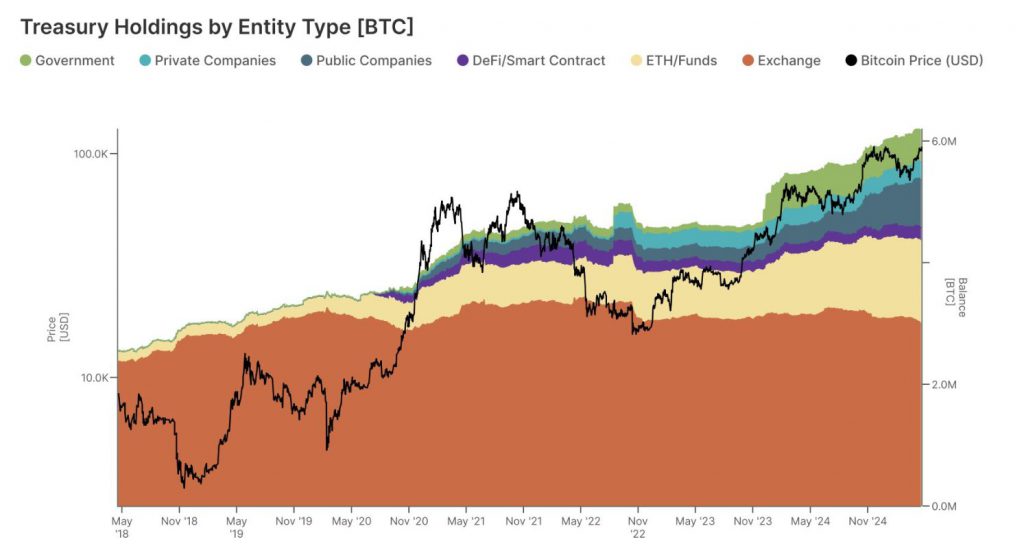
BTC Centralization has reached a critical 30.9% of Bitcoin’s total circulating supply, and this is checked by centralized government funds including governments, ETFs and also public companies. The institutional Bitcoin Holdings increase represents a huge increase of 924% since 2015, and these units are now controlling $ 668 billion in bitcoin at current prices. This BTC centralization shift raises serious concerns about Bitcoin’s market volatility and even crypto investment risks as the market is undergoing basic structural changes right now.
Also read: Uber enters ‘Studiate phase’ on bitcoin and crypto payments
How institutional bitcoin holding shapes risk, volatility and trust

Institutional accumulation drives BTC centralization
The information shows that centralized exchange custody about half of these institutional Bitcoin holdings for individual customers and retail investors. This accumulation constitutes serious crypto investment risks when massive movements occur of these wallets.
How do the Government reinforce market risks?
The Crypto investment risks become even more complex with state government funds. Countries such as the United States, China, Germany and even the UK have significant Bitcoin amounts, and most of this was acquired through legal enforcement measures rather than traditional market participation.
Researchers noted that sovereign government debt gears show rare movement but have enough bitcoin to significantly affect the markets. Bitcoin’s market volatility increases as these dormant holdings become active, which creates unpredictable price turns that can affect the entire Cryptocurrency system.
Market structure conversion
Bitcoin’s regulatory impact is intensified when institutional players provide traditional financial practice to the digital asset space. At the time of writing, BTC centralization has fundamentally changed how Bitcoin behaves in the markets, with institutional Bitcoin holdings that create more predictable but concentrated owner patterns.
The report shows that early adopters continue to shape institutional market structure, and this is most obvious in defi, public companies, ETFs and even funds. Private Company Holdings acts more distributed over a wider participant base, which provides a certain balance in the overall concentration trend.
According to the research, “The market has undergone a structural transformation against institutional maturity.”
Also read: Bitcoin: Stag yourself for a massive rally, BTC can hit $ 177K
Future consequences of centralized control
This institutional adoption creates a paradox where Bitcoin’s decentralized vision conflicts with growing centralized unit appeal. The surge in institutional BTC holding indicates that these units see it as strategic value storage, and this fundamentally changes its role in global financing.
Bitcoin’s regulatory effects continue to grow as traditional financial integration makes the price measures more reliable but less driven by speculative extremes. Crypto investment risks now include concentration problems together with traditional market vollatility factors that have always existed.
The researchers explain that although Bitcoin remains a risk-on-basis, its integration into traditional financing has made price measures more reliable and less driven by speculative extremes.